

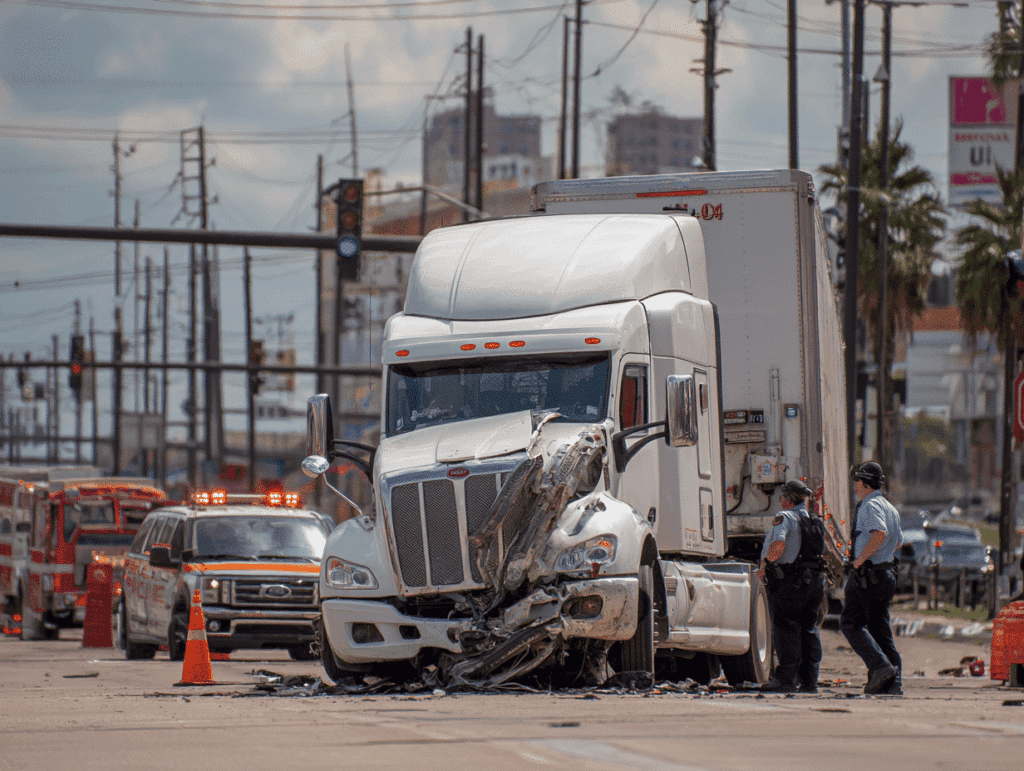
The mechanic might have signed off on faulty brakes. The shipping company might have overloaded the trailer past legal limits.
This complexity works to your advantage when you know how to use it. When multiple parties share blame, your chances of getting fully compensated increase. But it takes investigation, evidence, and someone who understands the freight industry’s regulations and shortcuts.
Let's Go Beyond, to Bring You Back
Let's get you the compensation you're entitled to. Get a FREE Consultation today.
Let's Go Beyond, to Bring You Back
You deserve the compensation you’re entitled to, call for your FREE Case Review today.
Primary Defendants in Truck Accident Cases
Most people assume the truck driver caused their accident. Sometimes that’s true. But commercial trucking involves a web of companies and contractors, each with its own duties and each capable of negligence.
The Truck Driver
Drivers can be held accountable when they cause crashes through their own actions. Speeding through construction zones on I-35, checking their phone while merging onto I-45, driving impaired, or ignoring weather conditions all represent direct negligence. If a driver fell asleep at the wheel after logging false hours, that driver bears personal responsibility.
But drivers are often employees or contractors working under tight deadlines with pressure from dispatchers. Their personal liability might be real, but they’re rarely the only responsible party.
The Trucking Company
Trucking companies have more money and insurance than individual drivers. They also have more responsibility under federal and state regulations. Trucking company liability comes into play when the company fails to properly train drivers, maintain vehicles, or follow hours-of-service rules.
A company that pushes drivers to meet impossible delivery windows shares blame when those drivers speed or skip mandatory rest breaks. Companies that hire drivers with suspended licenses or poor safety records can be sued for negligent hiring. When companies skip required drug testing or let drivers falsify their logbooks, they’ve created the conditions for disaster.
The Vehicle Owner
Sometimes the trucking company doesn’t own the rig. Leasing arrangements are common in the industry, which means the vehicle owner might be a separate entity entirely. If the owner failed to maintain the truck or leased it to an unqualified driver, they can be held liable regardless of whether they were anywhere near the accident scene.
Maintenance Providers
Trucks require constant upkeep. Brake systems need regular inspection. Tires wear down. Lights burn out. When a third-party maintenance shop or mechanic performs shoddy work or misses obvious defects, they can be sued. If a mechanic signed off on worn brake pads that failed two days later, causing a multi-car pileup, that mechanic and their employer share responsibility.
Cargo Loaders
Improperly secured cargo causes serious accidents. A load that shifts in transit can cause a truck to tip. Unsecured materials falling onto the highway create immediate hazards for other drivers. Cargo loader negligence happens when shipping companies or warehouse workers overload trailers, fail to balance weight distribution, or skip required tie-downs and straps.
Federal regulations specify exactly how different types of cargo must be secured. When loaders ignore these rules to save time, they’re legally responsible for the consequences.
Manufacturers
Sometimes the truck itself is defective. Manufacturer liability becomes relevant when design flaws or manufacturing defects cause crashes. Defective brakes that fail under normal use, steering systems that lock up, or tires that blow out prematurely all point to the companies that made those components. These cases require expert analysis and often involve recalls or service bulletins that the manufacturer ignored or downplayed.
Related Article(s)
Types of Truck & Commercial Vehicle Accidents in Houston
Truck Accident Lawsuit Timeline: Step-By-Step of the Claim Process
Negligent Hiring and Training
 Trucking companies face a driver shortage. That economic pressure tempts some companies to cut corners during the hiring process. When those shortcuts lead to unqualified drivers on the road, the company has committed negligent hiring.
Federal regulations require trucking companies to check a driver’s record before hiring. They must verify commercial licenses, review previous employment, check for DUI convictions, and examine the driver’s crash history. Companies that skip these steps or ignore red flags in a driver’s record can be held liable when that driver causes harm.
A driver who lost their commercial license in another state shouldn’t be driving in Texas. A driver with three accidents in the past year needs additional training or shouldn’t be hired at all.
When companies overlook these warning signs because they need bodies behind the wheel, they’ve made a choice that puts everyone else at risk.
Training matters just as much. New drivers need proper instruction on vehicle operation, safety protocols, and federal regulations. Experienced drivers switching to new types of rigs need training specific to those vehicles. Companies that provide inadequate training or rush drivers through certification programs share responsibility when those drivers make mistakes on the highway.
Truck Accident Attorney
Get Compensated For Your Injuries & Damages! Call Us For A FREE Case Review And Know What Your Case Is Worth.
Violations of Federal and State Regulations
The trucking industry operates under strict federal oversight through the Federal Motor Carrier Safety Administration. These aren’t suggestions. They’re legal requirements with serious consequences for violations. When companies or drivers break these rules, and someone gets hurt, those violations become evidence of negligence.
Hours-of-Service Rules
Driver fatigue kills. Federal hours-of-service regulations limit how long drivers can work and require mandatory rest breaks. A driver may drive no more than 11 hours after 10 consecutive hours off duty. After 14 consecutive hours on duty, they must stop driving. They must take a 30-minute break after eight hours of driving.
These rules exist because drowsy driving is as dangerous as drunk driving. When companies pressure drivers to falsify their electronic logs or when drivers ignore the rules to make extra runs, they’re gambling with other people’s lives. If a driver who’d been on the road for 15 straight hours rear-ended your car at a red light, those hours-of-service violations become powerful evidence of negligence.
Weight and Load Limits
Texas enforces both federal and state weight limits. An overloaded truck takes longer to stop, puts extra stress on the brakes, and becomes unstable in turns. The legal weight limit for most commercial vehicles is 80,000 pounds total. Individual axle weights also have specific limits.
Shippers and trucking companies sometimes overload trailers to move more freight per trip. This saves money but creates danger. When an overweight truck can’t stop in time or tips over in a curve, the company that authorized that illegal load shares responsibility for the crash.
Vehicle Maintenance Requirements
Federal regulations require regular inspections and maintenance. Drivers must complete pre-trip and post-trip inspections. Certain components require inspection at specific intervals. Maintenance records must be kept for at least one year.
Companies that defer maintenance to save money or forge inspection records commit serious violations. When those mechanical failures cause accidents, the company’s disregard for safety becomes clear evidence of negligence. Worn brake pads, bald tires, and broken lights are all preventable mechanical issues that shouldn’t exist on commercial vehicles.
Proving Liability: Key Evidence
Saying someone is liable and proving it in court are different things. Truck accident cases require specific evidence that shows who did what wrong. The good news is that trucking companies are required to keep detailed records. The bad news is they don’t always preserve that evidence unless forced to.
Electronic Logging Device Data
Most commercial trucks now use electronic logging devices that automatically track driving hours. This data shows exactly how long the driver had been on the road, when they took breaks, and whether they exceeded hours-of-service limits. ELD data doesn’t lie, which is why it’s some of the most valuable evidence in a truck accident case.
Companies must preserve this data, but they don’t always do so voluntarily. Getting this evidence quickly, often through legal preservation letters, becomes a priority after any serious truck accident.
Event Data Recorders
Like the black boxes in airplanes, many trucks have event data recorders that capture information about the vehicle’s operation in the moments before a crash. Speed, braking, steering inputs, and other data get recorded. This information can prove whether the driver was speeding, whether they attempted to brake, and how they responded to the emergency.
Maintenance and Inspection Records
Federal law requires trucking companies to maintain detailed service records. These records show when the truck was inspected, what repairs were performed, and what defects were found. Gaps in maintenance or repeated issues with the same system can prove negligent vehicle upkeep.
Driver Vehicle Inspection Reports completed before and after trips also provide evidence of known mechanical problems. If a driver noted malfunctioning brakes in their DVIR three days before a crash, that’s proof the company knew about the problem and failed to fix it.
Dispatch Communications
Text messages, emails, and recorded phone calls between drivers and dispatchers can show whether the company pressured the driver to violate hours-of-service rules or speed to meet delivery deadlines. A message telling a driver to keep moving despite bad weather or to skip a required rest break demonstrates corporate negligence.
Hiring and Training Files
A driver’s personnel file reveals what the company knew when they hired that person. Did they check references? Did they review the driver’s motor vehicle record? Did they conduct required drug testing? These files can prove negligent hiring when companies cut corners during the vetting process.
Training records show whether the driver received adequate instruction. A driver who causes a crash involving cargo that shifted might have never received proper training on load securement. That’s on the company, not just the driver.
Safety Ratings and Violation History
The FMCSA maintains public safety ratings for trucking companies. These ratings reflect the company’s history of violations and crashes. A pattern of hours-of-service violations or maintenance citations shows that the company regularly puts profits over safety. This history can be introduced as evidence of negligent corporate practices.
Let's Go Beyond, to Bring You Back
Let's get you the compensation you're entitled to. Get a FREE Consultation today.
Let's Go Beyond, to Bring You Back
You deserve the compensation you’re entitled to, call for your FREE Case Review today.
Multiple Defendants & Joint Liability
 Texas law handles cases with multiple at-fault parties through a modified version of proportionate responsibility. Under Texas Civil Practice and Remedies Code Chapter 33, each defendant is generally responsible only for their proportionate share of damages. If the jury finds the trucking company 60 percent at fault and the driver 40 percent at fault, each pays according to those percentages.
However, there’s an exception. If a defendant is found more than 50 percent responsible for the harm, that defendant can be held jointly and severally liable for all of the damages. This means if the trucking company is found 70 percent at fault, they could be on the hook for 100 percent of your damages such as medical bills, lost wages, physical pain, mental anguish and physical impairment even if other parties share some blame.
This proportionate responsibility rule affects settlement strategies. When you’re negotiating with multiple defendants, each party wants to minimize its percentage of fault. They’ll try to shift the blame to the other defendants. That tension can work in your favor, especially when the evidence clearly shows shared negligence.
Multiple defendants also means multiple insurance policies. A truck driver might carry $1 million in coverage. The trucking company might have $5 million. The maintenance company might have another $2 million. When your damages exceed what one policy can cover, having multiple responsible parties means you have a better chance of full recovery.
Cases with multiple defendants take longer to resolve. Each party conducts its own investigation. Each has its own lawyers making their own arguments. Settlement negotiations become more complex when three or four companies are pointing fingers at each other. But that complexity shouldn’t scare you away from pursuing all responsible parties. It just means you need someone who knows how to manage these cases.
Frequently Asked Questions About Liability
Can I sue both the driver and the trucking company?
Yes. You can pursue claims against every party whose negligence contributed to your injuries. The driver might have been speeding, but the company might have pressured them to meet an impossible deadline. Both can be held accountable.
What if the truck driver was an independent contractor?
Trucking companies often classify drivers as independent contractors to avoid liability. But the legal test for whether someone is truly an independent contractor goes deeper than what the contract says. If the company controlled the driver’s schedule, routes, and delivery deadlines, they might still be liable regardless of the driver’s official status. Courts look at the actual relationship, not just the paperwork.
How long do I have to file a claim?
Texas’s statute of limitations for personal injury claims is two years from the date of the accident. These deadlines are strict. Miss them, and you lose your right to sue, no matter how strong your case. Claims against government entities have even shorter deadlines and require specific notice procedures.
Do I need a police report to prove liability?
A police report helps, but it’s not the only evidence that matters. Officers don’t always determine fault at the scene, especially in complex truck accidents. What matters more is the physical evidence, witness statements, electronic data from the truck, and expert analysis. That said, you should always call the police after any serious accident involving a commercial vehicle.
What if I was partially at fault?
Texas follows modified comparative negligence rules. You can still recover damages even if you were partially at fault, as long as you’re not more than 50 percent responsible. Your compensation gets reduced by your percentage of fault. If you were 20 percent at fault and your damages total $100,000, you’d receive $80,000. But if you’re found 51 percent or more at fault, you recover nothing.
Will the trucking company try to settle quickly?
Sometimes, yes. Insurance companies for trucking companies sometimes offer quick settlements before you’ve had time to understand the full extent of your injuries or consult with a lawyer. These initial offers are almost always too low. They’re betting you’ll take the money and sign away your rights before you realize what your case is actually worth. Don’t accept any settlement without having someone review it first.
Truck accidents create complicated legal questions with high stakes. Medical bills from serious injuries can reach hundreds of thousands of dollars. Lost wages add up quickly when you can’t work. Pain and suffering matter, even if they’re harder to quantify. Getting the full compensation you deserve means identifying every responsible party and proving their negligence with solid evidence.
You don’t have to figure this out alone. If you’ve been hurt in a crash involving a commercial truck, contact us for a free liability assessment. We’ll review your police report and any trucking logs at no cost. You need to know who’s responsible and how to hold them accountable. That starts with understanding your case.