

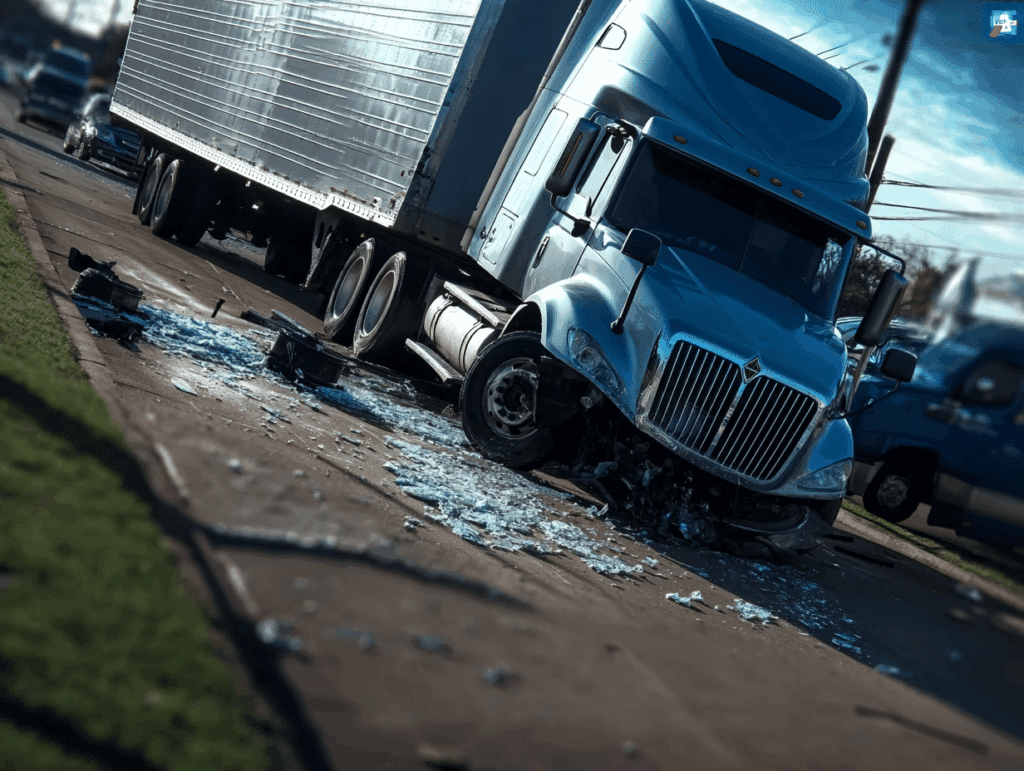
Following the initial injuries caused by the accident, immediately inform your insurer about what happened, follow through on all recommended treatment, document all expenses including hospital bills, prescriptions, lost wages due to missing time at work, etc., and tell them how the accident occurred. Tell the truth about what happened but avoid making any guesses about liability; consider consulting with a semi-truck accident lawyer before providing any statements (recorded or otherwise) to the trucking company’s insurance carrier or signing any kind of settlement agreement.

Injured in an Accident?
We’ll Go Beyond to Get You Back
Get Compensated For Your Injuries & Damages! Call Us For A FREE Case Review. Call Us For A FREE & Confidential Case Review Today!

Initial action at the Accident scene
First and foremost, get yourself to safety. If you can safely exit your vehicle without increasing the risk of additional injury, move to a location outside of traffic flow. Set up warning triangles or flares if you have them to alert other motorists.
In case of a serious accident, call 911. Texas law states that you are required to immediately report the incident to the proper authorities in cases where there is an injury/death, or damage to one (or both) vehicles is so severe that it makes it unsafe to drive the vehicle. Even though the wreck appears minor, having police document the incident provides a paper trail. Plus, sometimes injuries do not appear immediately, such as with head injuries, whiplash, internal injuries, etc.
Do not refuse medical evaluation at the scene. While adrenaline may mask pain and prevent detection of some injuries (like whiplash), it’s better to err on the side of caution and allow paramedics to evaluate you for injuries. Additionally, refusing medical treatment at the time of the wreck could create problems for you down the line when disputing your injuries with the insurance company.
Related Article(s)
Minimum Truck Settlement: What You Need to Know About Compensation
How to gather all of the information available?
As long as you remain at the scene, collect as much Evidence as you possibly can.
Take photographs and video using your cell phone of:
- All vehicles involved in the wreck: capture images of each vehicle from various angles.
- Where all vehicles were positioned on the road
- Skid marks, debris, road conditions
- Traffic signs and signals in close proximity
- License plate number and DOT number of the truck
- Company name of the trucking firm
- Company name of the trucking firm’s insurance provider (if known)
- Visible injuries to you and others
- Obtain Contact information from the truck driver
- Take down the truck driver’s contact information/license/employer/insurance
The state of Texas law requires the exchange of at least the name and address of the driver along with their vehicle registration number, as well as their liability insurance company, and to provide proof of identification by showing them your driver’s license if they ask for it.
Witness statements
Any person(s) who witnessed the occurrence can provide important testimony to support your claim. Obtain their names, addresses, and telephone numbers before they leave.
What not to say following the incident?
When discussing anything related to your Accident at the scene, be cautious regarding what you say. Do not express remorse or accept blame for what occurred. Do not speculate on who was at fault; Texas has laws that protect some forms of sympathetic statements from being used against someone during trial regarding who was liable for an accident. However, a verbal statement made by the party stating they were at fault will be viewed differently than other types of sympathetic statements.
Discuss what happened with police personnel solely in factual terms. Only describe what you observed; refrain from making any speculative or assumption-based comments about who was responsible for the collision.
Generally, you are not required to give an opposing liability insurance company a pre-suit recorded statement. However, your obligation(s) to your own insurance company and/or a formally litigated matter may be significantly different from that obligation to the opposing party’s insurance company. Insurance adjusters can ask exhaustive questions related to liability, injuries, and damages, and your answers can affect how the insurer evaluates the claim. Politely tell him/her that you will respond through your attorney.
Seek medical attention immediately
See a doctor or emergency room as soon as possible after your accident regardless of whether you’ve already received care from paramedics. Some injuries may take hours or days to present themselves.
Complete all recommended medical treatments and keep scheduled appointments. The unexplained gap in a recommended treatment that is considered reasonable may be a cause for a dispute regarding causation or damages based upon the specific case.
Maintain detailed records of all medical expenses.
In addition to receiving medical care, maintain accurate documentation of all associated costs with regard to treatment, for example: hospital bills, prescription medication, travel to/from appointments. Documentation of your damages will aid in establishing reasonable compensation for your losses.
Truck Accident Attorney
We’ll Go Beyond to Get You Back
Get Compensated For Your Injuries & Damages! Call Us For A FREE Case Review. Call Us For A FREE & Confidential Case Review Today!Notify your insurance provider
Contact your insurance carrier to notify them of your involvement in an Accident. You should notify your insurance company as soon as possible after the incident and fulfill all of the reasonable notice, proof, and cooperation obligations set forth in your policy. There is no necessity to record a lengthy account of events or enter into negotiations for a rapid payment prior to determining the scope of your sustained injuries.
When there are injuries, deaths, or damage that makes it unsafe for the vehicles involved in the accident, a Texas driver is obligated to contact an enforcement agency as soon as possible. The requirement to submit a $1,000.00 report to the Texas Department of Transportation (TxDOT) within ten days does not apply to the driver but to the officer conducting the investigation under Texas Transportation Code §550.026.
Make any immediate report to the law-enforcement agency required by Texas Transportation Code §550.026; Drivers typically do not complete the former Crash Report (CR-2), which would then need to be submitted to TxDOT.
Report as many specific details as possible relating to the event.
When reasonable anticipation exists that litigation will result from the crash, preserve all physical evidence from the crash to prevent any claims of spoliation if some part of the evidence is lost or destroyed.
Retain all damaged personal belongings associated with the accident, including torn clothing, broken glasses/phone, etc. Physical evidence may help establish how the crash occurred and the extent of damages, but liability depends on the evidence establishing fault and causation.
If practical, avoid repairing or disposing of the vehicle until its condition is documented and interested parties have had a reasonable opportunity to inspect relevant damage.
Take photographs of your vehicle in its entirety prior to it being repaired, both interior and exterior views from all angles. Those photos may be used to establish a record of the vehicle’s condition and any visually observable damage prior to repair.
How does Liability coverage for commercial trucks work?

Commercial-truck financial-responsibility minimums differ by the carrier’s operations, vehicle, and cargo as follows:
Applicable federal minimums commonly range from $750,000 to $5 million, with $750,000 for qualifying general interstate freight, 1 million for specific hazardous materials, and $5 million for extremely risky hazardous materials.
The insurance coverage required for cargo is dependent on both the carrier and the cargo. Federal laws do not require all commercial truck carriers to obtain a certain level of cargo insurance. Trucking companies are able to buy “umbrella” (or “excess”) coverage for certain types of accidents; however, it is federal law that makes it mandatory for all commercial carriers to have an “umbrella” (or “excess”) policy.
Depending upon who was driving the vehicle, what type of vehicle was being driven, what type of cargo was in the vehicle at the time of the accident, and which parties were affected by the accident, a truck collision may be subject to more than one policy or layer of coverage.
In addition to potentially having multiple policies covering the same party, the way each defendant has structured its insurance coverage can also vary.
Commercial insurers can also employ investigators and attorneys to evaluate liability, damages, coverage, and potential defenses.
Trucking companies and insurers can start investigating serious crashes immediately, making prompt preservation of available evidence important.
A legal gross weight typically has a maximum limit of 80,000 pounds. However, larger vehicles are allowed under certain permits or as part of statutory exemptions for emergencies.
| Step | What To Do | Why It Matters |
|---|---|---|
| 1. Put Safety First & Call 911 | Immediately move to a safe spot away from traffic, turn on hazard lights, and use cones/flares if you have it with you. Call 911 so police and EMS can respond, even if the crash seems minor. | Documentation from law enforcement in regards to police involvement will help generate an official document. When (§)550.062 applies, the investigating officer is required to submit a collision report. |
| 2. Accept On-Scene Medical Care | Allow paramedics to evaluate you, even if you “feel fine.” Don’t downplay symptoms or reject care. | Adrenaline can hide serious injuries. Immediate medical evaluation can create simultaneous documentation of your symptoms, although insurers can still dispute the cause or severity of an injury. |
| 3. Document the Scene | Take photos/videos of all vehicles, damage, skid marks, debris, road and weather conditions, traffic signs, the truck’s plate/DOT number/company name, and your visible injuries. Get names and phone numbers for the truck driver and any witnesses. | Strong visual and witness evidence helps prove how the collision exactly happened and assists your version of events later. |
| 4. Watch What You Say | Do not apologize, admit fault, or speculate about what caused the crash. When speaking with police, strictly stick to the facts. Never provide any recorded statement for the trucking company’s insurer until you talk to an attorney. | Even simple phrases like “I’m sorry” can be twisted to blame you. A recorded statement can later be considered when the insurer evaluates liability, injuries, and damages, so give attention on getting legal advice before giving one to an opposing insurer. |
| 5. Get Follow-Up Medical Treatment | Visit an ER, urgent care, or your doctor without wasting time. Follow all treatment recommendations, attend appointments, and keep all the copies of bills, records, and prescriptions. | Continuous medical care shows the seriousness of your injuries and provides the documentation required to calculate fair compensation. |
| 6. Report the Crash to Your Insurer | Notify your insurance company immediately and share basic facts about the collision. Never agree to detailed recorded statements or quick settlements before you understand your injuries. | Timely notice is mostly required by your policy. Carefully limiting what you say helps you avoid mistakes that could reduce your recovery. |
| 7. Preserve Physical Evidence | Always Save damaged clothing, personal items, car seats, and other objects from the crash. Don’t repair or get rid of your vehicle until it has been carefully and comprehensively photographed as well as inspected. | Physical damage mentions the story of how severe the impact was and can be critical evidence in settlement negotiations or trials. |
| 8. Understand Trucking Insurance | Commercial trucks typically carry high policy limits and multiple layers of coverage. Several parties including the driver, trucking company, cargo owner, manufacturer, and maintenance providers can be involved in the fault. | Additional potentially liable parties and applicable insurance may provide additional sources of recovery, but majorly compensation always depends on liability, damages, coverage and defenses. |
| 9. Don’t Rush to Accept a Settlement | Anticipate the trucking company’s insurer to connect with you quickly with a “fast” offer. Avoid signing any documents or accepting money before you fully know the full extent of your injuries and future needs. | An early settlement offer can be made before the full extent of injuries and future losses is known, therefore, it should be evaluated carefully before acceptance. Once you sign a release, you typically can’t ask for more later. |
| 10. Talk to a Truck Accident Attorney | Contact an experienced 18-wheeler accident lawyer at Wyly & Cook Injury & Insurance Lawyers for a FREE case review. In addition to investigating any potential defendants and pursuing all possible causes of action, we also need to consider any applicable defenses such as government or common law immunity, statute of limitations, notice provisions and other special requirements. | Trucking companies employ teams of lawyers protecting their interests. An attorney can pursue compensation backed by the evidence and applicable Texas law, subject to liability, defenses, available coverage, and the background/overall condition of the case. |
How does insurance work when It’s Not your fault?
Additionally, you would need to find out if you have any UM/UIM or PIP coverage, or any other relevant coverage for which you could be entitled to benefits.
In the event the other party is found to be liable (legally), the liability portion of the defendant’s insurance will provide you with payment for any actual damages you incurred (bodily injury and/or property damage) based on the defendant’s applicable liability limits. An opposing insurer can seek information to evaluate a claim, but a third-party claimant does not have a general obligation to comply with every pre-suit request; therefore, once litigation begins, the parties need to comply with applicable court rules and formal discovery obligations.
Texas uses what is called a “modified” comparative negligence law. Texas follows the theory of comparative negligence. If it is determined that a claimant is more than 51% responsible for his/her own injuries, then he/she will not be able to recover anything from the tortfeasor. If it is determined that the claimant is 50% or less responsible for his/her own injuries, then he/she will receive an award based upon what percent of responsibility he/she had.
Additionally, when you’re awarded damages, those dollars will be reduced by the amount of fault attributed to you. For example, if you were determined to be 20 percent at fault for the wreck, you would get paid 80 percent of the total award.
The insurance company handling the claim for the negligent driver will likely send investigators out to inspect the crash site; talk to witnesses; view the damage done to both vehicles; and study the police report. What the investigator wants is to find some way to either deny your claim or reduce the amount of money he pays you.
You don’t necessarily have to accept the insurance company’s first offer. It is not necessary for you to accept an insurer’s first offer. An attorney can simply evaluate the offer in light of the available evidence, damages, insurance coverage, and applicable Texas law.
Injured in an Accident?
We’ll Go Beyond to Get You Back
Get Compensated For Your Injuries & Damages! Call Us For A FREE Case Review. Call Us For A FREE & Confidential Case Review Today!Which type of injury is hardest to prove?

The challenge of proving soft-tissue injuries will depend on the disputed issue of how severe they are, whether the defendant’s actions caused them, and how long they lasted. Soft-tissue injuries are injuries to muscle tissue, tendons, and/or ligaments, which cannot be seen on standard X-rays or MRI images. Common examples of soft-tissue injuries include sprains, strains, whiplash, and pulled muscles.
Because they do not produce clear-cut evidence like broken bones or scar tissue, many people believe that soft-tissue injuries are fabricated. However, soft-tissue injuries can result in chronic pain and limited functionality. Evidence needed to prove the injury, as well as who was at fault, is determined on a case-by-case basis. When there is a dispute about the medical reasons that led to the injury, and those would not typically be understood by jurors in general, expert testimony may be necessary.
Mental/psychological injuries such as post-Traumatic stress disorder (ptsd), anxiety, and depression are also very difficult to prove. Since mental trauma cannot be visually identified by insurance adjusters, they typically have doubts regarding claims involving mental trauma. Documenting your mental health-related symptoms and treatment through working with a mental health professional will create a stronger record of your mental injuries.
Traumatic brain injuries (TBIs) are in a gray area when determining whether to classify them as severe, moderate, or mild. While severe TBIs will display signs of TBI on a CT scan, mild TBIs or concussions will not always appear on imaging studies, although they may still produce symptoms such as memory loss, headaches, difficulty concentrating, etc.
Contact an Experienced truck accident attorney regarding 18-wheelers
Many individuals who have been involved in truck crashes often hire attorneys because of the complexity of the evidence, rules, and laws. Trucking companies and their insurers can also involve investigators or attorneys urgently after a serious crash.
A qualified attorney will conduct a thorough investigation of your accident, including identifying all responsible parties and available insurance policies. He/she will handle correspondence with the insurance companies representing the negligent parties to protect you from making statements that can negatively impact your case.
Attorneys knowledgeable of federal motor carrier regulations and Texas transportation laws are well-versed in collecting and preserving evidence related to the accident, including black box data from the truck; driver log books; maintenance records of the trucking company; and internal safety documents of the trucking company, which may disappear if they are not collected quickly enough.
We offer contingency-fee representation in qualifying cases. Attorney fees are definitely payable from a recovery. [Clients are / are not] responsible for litigation expenses, as specifically explained in the written fee agreement.
This enables individuals who suffer devastating losses due to tractor-trailer wrecks to afford quality representation without paying up front fees during an already economically taxing period.
Wyly & Cook Law Firm understands the physical, emotional, and economic effects suffered by victims of 18-wheeler accidents and families affected by those accidents. Our attorneys handle personal-injury and insurance matters involving commercial vehicles and can investigate claims involving trucking companies and their insurers.
Because truck-accident claims usually involve complex evidence, insurance issues, and deadlines, consider speaking with an attorney quickly about your options. Contact us today to schedule a complimentary consultation to discuss your case and learn about your rights regarding recovering fair compensation.
Attorney responsible for this post: Brad Wyly. Primary practice location: 1415 N Loop West, Suite 1000 Houston, TX 77008